> ## Documentation Index
> Fetch the complete documentation index at: https://docs.revolte.ai/llms.txt
> Use this file to discover all available pages before exploring further.
# What is Revolte
> Revolte — Autonomous AI SDLC for Agentic Software Delivery
Revolte is an AI-native software delivery platform that helps engineering teams move from intent to production through one connected execution system.
It brings planning, code generation, validation, pull request review, deployment, and observability into a governed workflow where AI executes the work and teams remain in control.
***
## Why Revolte?
Traditional delivery is fragmented. Requirements, code, and deployments live in isolated silos, causing context loss and manual bottlenecks.
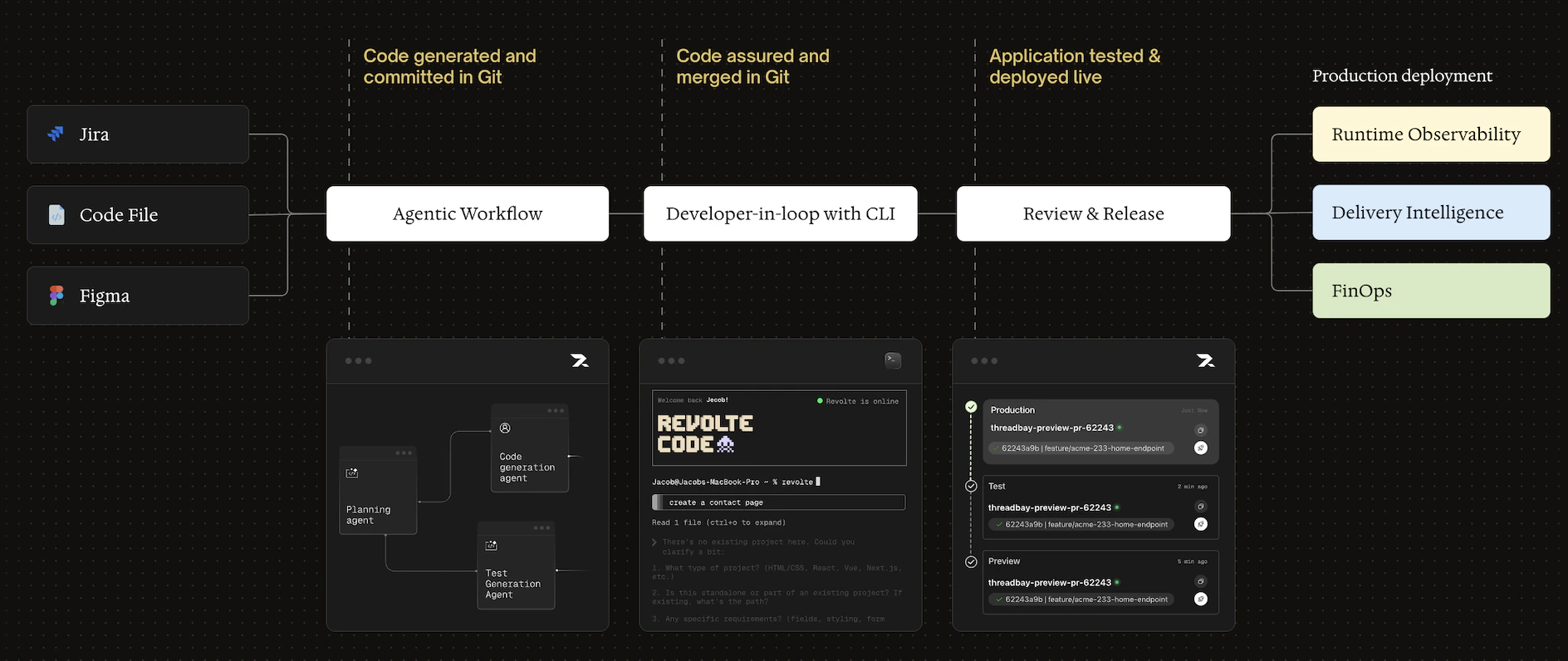
**Revolte closes these gaps.** It connects your entire delivery lifecycle—from the first ticket to the final health check—into a single, context-aware workflow.
***
## Unified Delivery Architecture
Revolte understands your repositories, environments, and deployment systems as part of a single workflow.
Execution goes beyond code generation to include automated validation, deployment, and runtime verification.
Your organizational standards and security policies are built directly into the workflow, ensuring every PR is safe to ship.
Signals from production feed back into future workflows, helping Revolte make deployment-aware decisions over time.
***
## Core Platform Capabilities
* **Execute from Intent** — Turn planning tickets into production-ready PRs with full repository context.
* **Automate Governance** — Enforce security, architectural, and quality standards before human review.
* **Orchestrate Deployments** — Manage ephemeral environments and production rollouts with automated health checks.
* **Close the Feedback Loop** — Integrate runtime signals directly into the development cycle for faster recovery and refinement.
* **Scale Team Standards** — Use reusable templates to ensure consistent delivery across microservices and platform tools.
***
## Beyond Coding: The Autonomous SDLC
While standalone AI assistants (like Cursor or Codium) excel at helping individual developers write code or summarize files, Revolte is built to orchestrate the entire software delivery process.
* **End-to-End Orchestration** — Move beyond file-level edits. Revolte manages the transition from a planning ticket to a verified, deployed service.
* **Contextual Intelligence** — Execution is informed by your entire ecosystem—including infrastructure state, deployment histories, and security policies—not just active code.
* **Autonomous Verification** — The platform doesn't just generate drafts; it executes automated validation loops to ensure every PR meets production standards.
* **Production-Aware Development** — Runtime signals feed directly back into the development workflow, enabling autonomous incident resolution and performance tuning.
***
## The Connected Delivery Lifecycle
Revolte acts as an operating layer across every stage of development:
* **Planning** — Turn high-level intent into scoped, executable tasks with full repository context.
* **Development** — Delegate implementation, refactoring, and boilerplate to parallel workflows while you focus on architecture.
* **Validation** — Submit PRs that are already verified against your security and testing policies.
* **Release** — Coordinate rollouts with integrated health checks and automated recovery controls.
* **Operations** — Resolve production issues using the same governed systems you use for new features.
***
## Recommended Practices
* **Write Clear Requirements** — Execution quality depends on clarity. Provide explicit acceptance criteria for the best results.
* **Index Your Repositories** — Connect your codebase so Revolte has the full context of your architecture and dependencies.
* **Define Your Guardrails** — Use policy configurations to automate your team's standards and security requirements.
* **Delegate Repetitive Work** — Let Revolte handle migrations, test generation, and boilerplate so you can reclaim deep-work time.
* **Review with Confidence** — Treat Revolte's output as an operationally verified draft ready for final expert review.
***
## Platform Comparison
Capability
Traditional SDLC
Revolte
Standalone AI
{[
{ cap: "Workflow", bad: "Fragmented tools, manual handoffs", good: "One connected, governed system", meh: "Disconnected, prompt-driven tasks" },
{ cap: "Implementation", bad: "Manual coding, repetitive setup", good: "Context-aware implementation", meh: "Code without system context" },
{ cap: "Validation", bad: "Manual testing and review cycles", good: "Integrated policy and logic checks", meh: "Requires manual verification" },
{ cap: "Deployment", bad: "Separate CI/CD and infra pipelines", good: "Environment-aware rollout loops", meh: "No native deployment support" },
{ cap: "Observability", bad: "Disconnected monitoring tools", good: "Direct feedback from production", meh: "No runtime visibility" },
{ cap: "Context Awareness", bad: "Manually assembled task context", good: "System-wide context across the SDLC", meh: "Relies on manual prompts" },
{ cap: "Scalability", bad: "Increased coordination overhead", good: "Standardized, multi-team delivery", meh: "Built for individual productivity" },
{ cap: "Governance", bad: "Hard to standardize across teams", good: "Centralized controls and guardrails", meh: "Limited organizational controls" },
].map((row, i) => (
{row.cap}
{row.bad}
{row.good}
{row.meh}
))}
***
## Platform Systems
* **[AI Workflows](/ai-workflows/overview)** — Autonomous implementation, automated validation, and governed execution.
* **[YAML Configuration](/yaml/overview)** — Define your execution systems and delivery policies through the `revolte.yaml` specification.
* **[Deployments](/deployments/overview)** — Coordinate services, infrastructure, and operational runtime workflows.
* **[Integrations](/integrations/cloud/overview)** — Connect your planning tools, repositories, and cloud providers into a unified layer.
***
## Next Steps
Ship your first autonomous workflow in minutes.
Explore AI Workflows
Orchestrate delivery using `revolte.yaml`.
 ***
## Why Revolte?
Traditional delivery is fragmented. Requirements, code, and deployments live in isolated silos, causing context loss and manual bottlenecks.
**Revolte closes these gaps.** It connects your entire delivery lifecycle—from the first ticket to the final health check—into a single, context-aware workflow.
***
## Unified Delivery Architecture
***
## Why Revolte?
Traditional delivery is fragmented. Requirements, code, and deployments live in isolated silos, causing context loss and manual bottlenecks.
**Revolte closes these gaps.** It connects your entire delivery lifecycle—from the first ticket to the final health check—into a single, context-aware workflow.
***
## Unified Delivery Architecture